RESEARCH NOTE 003 / 16 OCTOBER 2026
Construction.
Capacity.
The full cost question.
To test Canada’s productive potential, follow an improvement through the whole process—from factory work to accepted buildings.
A Canadian project gives us measured panel-installation rates and reported costs. We publish the arithmetic, a runnable research package and the measurements needed to test a larger productive gain.
01 / A measured Canadian process
Faster panels.
A precise denominator.
Brock Commons Tallwood House at UBC delivered 404 student beds and shared spaces. Its construction study records changing panel-installation productivity across floors.
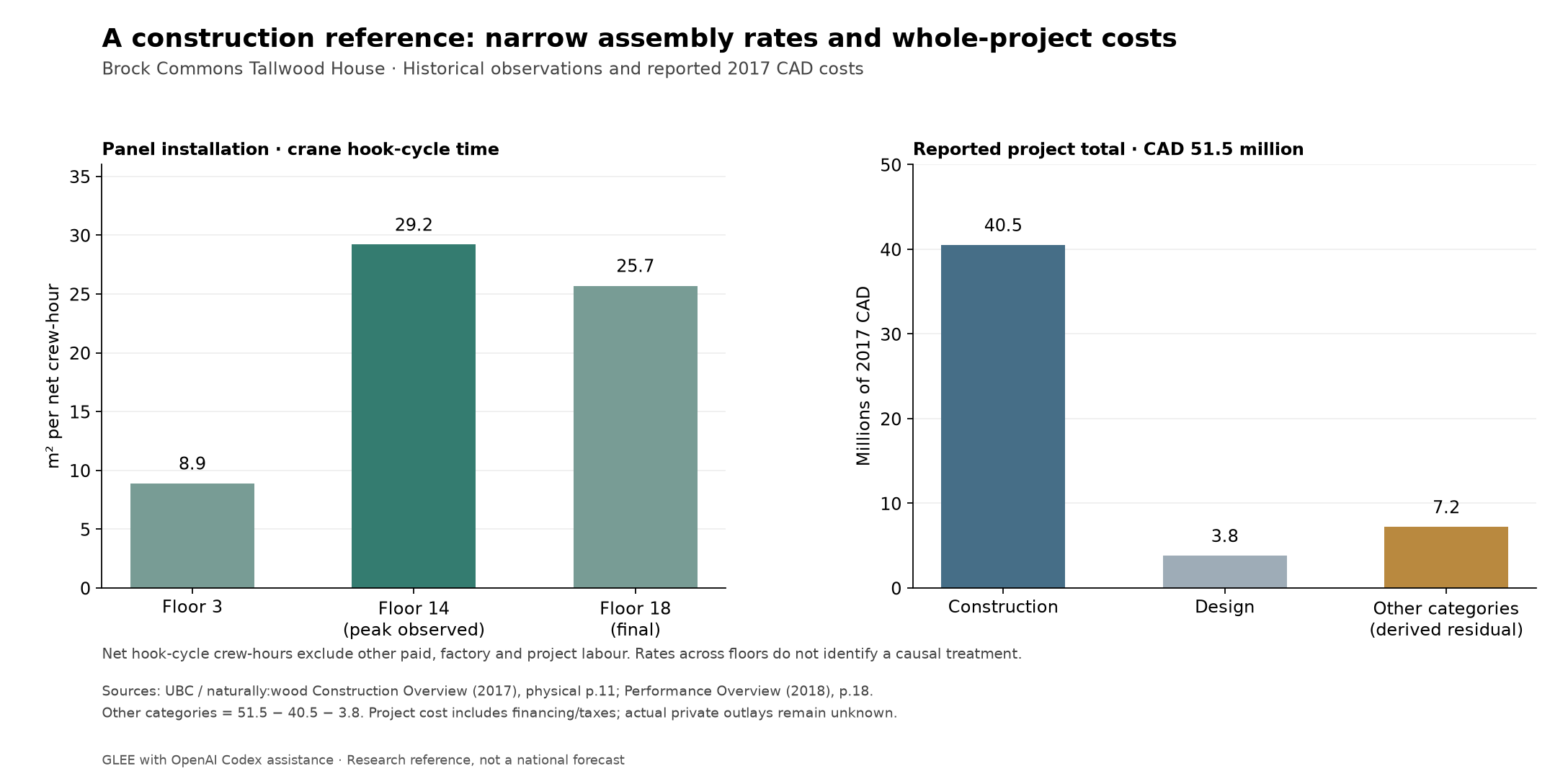
| Observed floor | m² per net crew-hour | Derived net hours per 722 m² |
|---|---|---|
| Floor 3 | 8.9 | 81.12 |
| Floor 14, observed peak | 29.2 | 24.73 |
| Floor 18, final | 25.7 | 28.09 |
The improvement is specific.
The peak rate is about 3.28 times the initial rate. For the same panel area, that corresponds to about 69.5% fewer narrowly counted hook-cycle hours. The final-floor rate is lower than the peak.
The whole building needs more.
These hours exclude other paid site, factory, design and project labour. Weather, changing crews and floor order also vary. Construction lasted about 18 months; faster assembly alone does not measure total building productivity or its cause.
Source: Construction Overview, physical PDF pages 3, 8 and 11. The final-floor value is transcribed from the chart. Both publications describe the same project and overlapping research team.
02 / Compare complete alternatives
Time has value.
Cost still matters.
The performance study reports historical costs and an estimated premium against a theoretical concrete building. That comparator was not a completed matched control.
| Measure | Amount | Basis |
|---|---|---|
| Total project | 51.5 | Includes management, permits, utilities, financing and taxes |
| Construction | 40.5 | Reported construction scope |
| Design | 3.8 | Reported design scope |
| Other categories | 7.2 | Derived residual; does not isolate land |
| Construction premium | 2.7 | Manager estimate against theoretical concrete equivalent |
The study reports roughly CAD 4.5 million in demonstration support, allocated to design and construction. Its wording does not establish actual private outlays or whether every cost figure is before support. The package keeps those outlays unknown. A transfer does not erase installed resource use.
Inspect the financing sensitivity and its limits
The package tests assumed financing credits of zero, about CAD 140,192 and CAD 841,154. Each leaves a positive balance against the CAD 2.7 million construction premium. These sensitivity cases use hypothetical completion benefits and capital exposure; they are not observed project returns.
A nine-week erection-stage advantage against a theoretical alternative may not become a nine-week occupancy gain. Delays elsewhere can reverse it. Reported project cost already includes financing, so these incremental credits must not be subtracted again from that total. Current replacement cost, full recurring costs, quality differences and household prices remain unmeasured.
Source: Performance Overview, physical PDF pages 18–19. A faster process can be useful while its full economic case remains open. National and household gains are unestimated.
03 / Inspect the work
Download.
Run. Challenge.
The research package runs locally with Python’s standard library. It includes source facts, original publication URLs and hashes, models, recorded results and meaningful adverse cases.
python3 run.py
python3 verify.py
Unzip and run those commands inside the package folder. No account, key or model service is needed. The 17 checks cover declared arithmetic and edge cases; they do not establish an external causal or national result. Optional figure rendering uses matplotlib separately.
Check the download and use it carefully
ZIP SHA-256: ce5972f367c27e55ed3c03e967826abae10ea5aefc52b56063043a2e1b2e72d8
FILES.json records file hashes within the package. Source PDF hashes are separate. The raw publisher PDFs and images are linked rather than redistributed. The package labels changed inputs as assumption experiments and retains missing observations as null.
Source/model criticism used separate AI contexts with the same provider. Independent field replication and separate-provider publication review remain outstanding. GLEE prepared this analysis with OpenAI Codex assistance.
04 / Test coordination too
What changed?
What caused it?
Changing technology and coordination together makes their separate contributions hard to identify. The package contains an explicitly synthetic diagnostic of that problem.
| Technology | Ordinary capable planning | Defined shared planning |
|---|---|---|
| Conventional | Outcome unknown | Outcome unknown |
| Prefabricated | Outcome unknown | Outcome unknown |
The first measurement needs equal accepted service and quality, all paid factory/site/design time, full installed and recurring costs, ordinary adoption, cheap standardization and a dependency schedule. Shared planning must have an operational definition and measured overhead.
Four algebraic design rows do not prove causality. Feasible arms, comparable selection, samples and spillovers still matter. A project-level coordination result would also leave the additional effect of national mobilization to be tested.
PRIMARY SOURCES
Follow the evidence.
- Brock Commons Tallwood House: Construction Overview, November 2017. Physical pages 3, 8 and 11.
- Brock Commons Tallwood House: Performance Overview, March 2018. Physical pages 18–19.
This note is a historical engineering reference and reproducible method. Total paid labour, matched whole-building effects, available national resources and household prosperity remain open research questions.
← Return to GLEE Research